
My social media feed is full of posts dealing with Yuval Avraham and Rachel Szor’s documentary NAZA. The Guardian,which produced the film (with executive producer Jonathan Glazer, director of “The Zone of Interest”), describes it in terms that can only be described as genocidal lyricism:
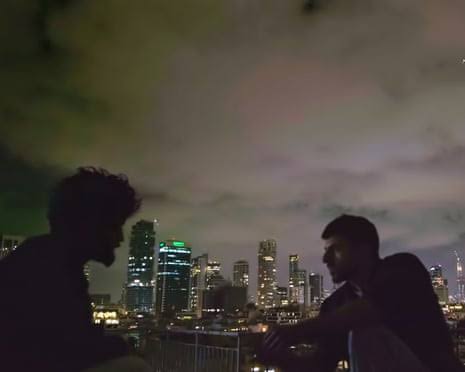
On a darkened rooftop in Tel Aviv, Israeli intelligence officers outline the details of their work. These men tell us how they helped develop an AI mapping tool that trawled for phone signals and recommended apartment buildings in Gaza to bomb. Indirectly, they admit, they are responsible for thousands of deaths, but they never spoke up because that wasn’t their place. “My role is technical,” says one. “I’m just a small cog,” says another. Naza… is a chilling documentary about a mass slaughter that was authorised at the highest levels of government. But it is also, primarily, about the process, the system, the little links in the killing chain. Szor and Abraham build their film around the accounts of 24 anonymised military and intelligence insiders. NAZA, we learn, is an acronym used by the intelligence service to indicate how many civilians it expects to die in an airstrike on Gaza. The Israel Defence Forces prefer to target Hamas terrorists in their homes at night – and if they live with their family, or in heavily populated neighbourhoods, too bad. At one point, a source claims, approval was given to kill 500 NAZA for one Hamas member.
NAZA is a Hebrew military acronym meaning “collateral damage,” or more accurately, the murder of uninvolved civilians, including women, children, elderly and disabled relatives of insurgents – regardless of their involvement, or perhaps because after the 7 October act of anti-colonial insurgency, the zionist view has always been that “there are no innocents in Gaza.” Social and legacy media comments on the film – particularly following the standing ovation and special jury prize at the 2026 Venice Film Festival – were either ecstatic or downright hostile. On the one hand commentators expressed gratitude to the film makers for “exposing” the systemic zionist genocidal machine, even though the details of employing AI to identify Hamas targets including their families have been known for at least two years, mostly thanks to Yuval Avraham’s reports for 972 Magazine and The Guardian. On the other hand, amidst the sea of hostile zionist reactions, a government minister called to strip the film makers of their israeli citizenship; the IGF Chief of Staff called the film “a blood libel” and floated a legal investigation of the film makers; and hundreds of reservists from the top military intelligence unit 8200 petitioned their commanders to discover if interviewees were members of the unit, the “values” of which, they claimed, were damaged by the film.
It didn’t take long for some more nuanced criticisms by the “left zionist” camp to surface. One example was journalist Raviv Druker who wrote that although the film shocked him to the core, it lacked any verifiable details including interviewees’ names, and the dates and locations of the AI assisted murders, and obscured Hamas’s 7 October 2023 “massacre,” and thus risks “alienating the israelis it needs to reach.”
I want to propose a different reading of the film – which, let me stress, I have not watched and have no intention of watching, as the information has been well documented for at least two years. In the rush to belatedly join those who did recognise, albeit belatedly, that what the zionist entity continues to perpetrate in Gaza is genocide, many zionist “lefties” – including human rights organisations, and film makers, rushed to express their support for Avraham and Szor. But I have to ask whether they are doing so as an insurance policy for the day of reckoning? Moreover, I propose that the anonymous interviewees themselves, speaking under the cover of darkness in the safety of Tel Aviv, occupied Palestine, without giving any details (and in this respect I agree with Druker), actually meant to provide themselves with pre-reckoning insurance so they would be able to say when judgement comes, “it was I who spoke on the roof, who exposed the system, who spoke about the collateral damage we caused…”
I don’t doubt Avraham and Szor’s sincerity in believing that documenting and screening the AI assisted remote control systematic slaughter of innocent civilians would make “the world” understand the nature of the genocide that the entity continues to perpetrate in Gaza. However, I cannot feel any enthusiasm about the film or about its success In Venice, The Venice Film Festival clearly intended to reflect “humanitarian” western values, while the western empire continues to fund and support the zionist genocide in Gaza and Lebanon and the imperialist wars against Iran and Yemen. Nor am I shocked by the zionist regime’s proposal to strip Szor and Avraham of their israeli citizenship. Why would anyone wish to continue to be a citizen of a genocidal entity, instead of being committed to its demise and to the decolonisation of Palestine?
As Ronit Chitayat Kashi writes in her Facebook page, the term NAZA, or collateral damage, has been explicitly used in relation to previous rounds of the zionist genocide in Gaza. “In the film a soldier speaks about ‘permission to take 500 for one man’”… And the question of whether 500 is a reasonable number is not discussed, “but the predetermined threshold of annihilation already includes the crime of mass murder. The number does not determine the right of the imperialist entity to decide who deserves to be murdered, giving it the ‘right’ to murder them, and determining how many other people it can murder alongside them… One ‘target’ organises mass murder which is part of an accumulated genocide.”
So, against left zionist comrades’ enthusiastic support for Avraham and Szor – I want to argue, first, that centring Israeli voices over Palestinian voices is racist to the extreme – Palestinians have been speaking about the genocide since it started and no one paid any heed. Second, and more importantly, the film is not really about collateral damage (NAZA) because the target has always been not Hamas and the other Palestinian fighters, but rather the Palestinian people, not only in Gaza, but throughout Palestine, to whose genocidal elimination the zionist entity has been committed ever since its establishment in 1948. The collateral damage in this scenario is not the civilian population – the actual target of the genocide – but rather any Hamas and other Palestinian insurgents murdered in the rush to eliminate the natives – the aim of the zionist settler colony like all settler colonies, as argued inter alia by Patrick Wolfe.
At the risk of alienating pro-Palestine activists – most of whom stop short of supporting direct action and armed resistance, I want to further argue that the film will become, has already become, a key component in the zionist hasbara machine. Not only does it help the colony to boast humanism and democracy (“see, we allow freedom of speech, even when we do not like the messenger!”), but it also centres the voices of zionist jews who remain “eternal victims” while Palestinians continue to be disbelieved and massacred in their tens of thousands. Even if Szor and Avraham are penalised by the zionist colony, even if they are ostracised, and despite hostile acts such as mobs protesting outside Szor’s family home, the film makers have gained their five minutes of fame and will go down in history as another epitome of the zionist “shooting and crying” ethos.