
Of all his immigrant friends my father Michael-Miki Salzberger had been in the country the longest. In 1925, aged thirteen, he migrated to Palestine from Vienna, his parents having moved there in 1915 from the northern Romanian province of Bucovina, then part of the Austro-Hungarian Empire. Miki and his parents were brought to Al Quds by his brothers – 20 and 24 years his elders.
Miki’s was a typical migrant Jewish boyhood in Al Quds, Palestine. He worked hard at passing for a sabra and resembling his school friends – most of them also children of recent settlers. An early photograph shows a dark eyed, European boy in a sailor suit, so different from the ideal type rougher zionist children, even though everyone was a migrant, apart, that is, from the Palestinians. Having studied engineering in Prague, Miki worked for the British state oil company in Iraq and then found a job in Haifa, where he met my mother Lia Schieber, the daughter of a wealthy timber merchant from Bucovina. Lia worked for the British air force in Haifa, rented a room from Miki’s brother, and so Haifa became my accidental birthplace.
In April 1948 the zionist militia, the Haganah, overcame the Palestinian population of Haifa, expelling and decimating its Palestinian community. This is a partial account of the zionist conquest of Haifa, and of my father’s part in it.

Haifa, Palestine
There is a gap between the Palestinian image of Haifa as a Nakba symbol and the zionist view of the city as a model of “Arab-Jewish co-existence”, an image that wilfully ignores the complete destruction of Haifa’s old city and the erasure of its Ottoman and Palestinian past. In her study of the Palestinian neighbourhood Wadi al Saleeb, destroyed by the zionists during the Nakba, resettled by North African Jewish migrants and demolished in the 1970s, Yif’at Weiss suggests that the work of memory needs to slow down the near-total erasure of Palestinian Haifa, so as to put a mirror to its indigenous inhabitants, whose existence continues to cast a long shadow on the city which became Jewish in one fell swoop. The account of the fall of Haifa has a deep resonance for me, which is why I want to put the dark backing to the mirror of Haifa’s previous inhabitants, making visible the contested histories of the city and its 1948 destruction.
Though mostly agrarian, a third of pre-1948 Palestine’s Palestinian population lived in cities. Manar Hassan critiques the erasure of the Palestinian city from both the zionist and the Palestinian collective memory, resulting in “imagining Palestinian society as a rural society… (making it is hard) to believe that historic Palestine, that is pre-NakbaPalestine, consisted of real cities.” Situated on the Mediterranean Sea at the foot of Mount Carmel, Haifa was the largest of these real Palestinian cities.
The Palestinian story tells of Haifa gradually developing from a fishing village to a major seaport due to its strategic importance to both the British Mandate authorities, and to the zionists. Haifa’s origins are ancient, but the present-day city dates to the late eighteenth century when it was established by Zahir al-Umar, the strongman of northern Palestine. Haifa was briefly conquered by Napoleon’s army in 1799 before coming under direct Ottoman rule in 1840. In 1869 German farmers from the Christian Templar Society settled in Haifa and in the 1880s, before the onset of political zionism, European Jews began settling in the city. Haifa was transformed by the period’s global economy; by World War I, Haifa replaced Beirut as the main port serving northern Palestine, southern Syria, and Transjordan. The city’s development was accelerated during the British Mandate, as Haifa became the terminus of an oil pipeline extending from Iraq, housing an oil refinery (www.palestineremembered.com).
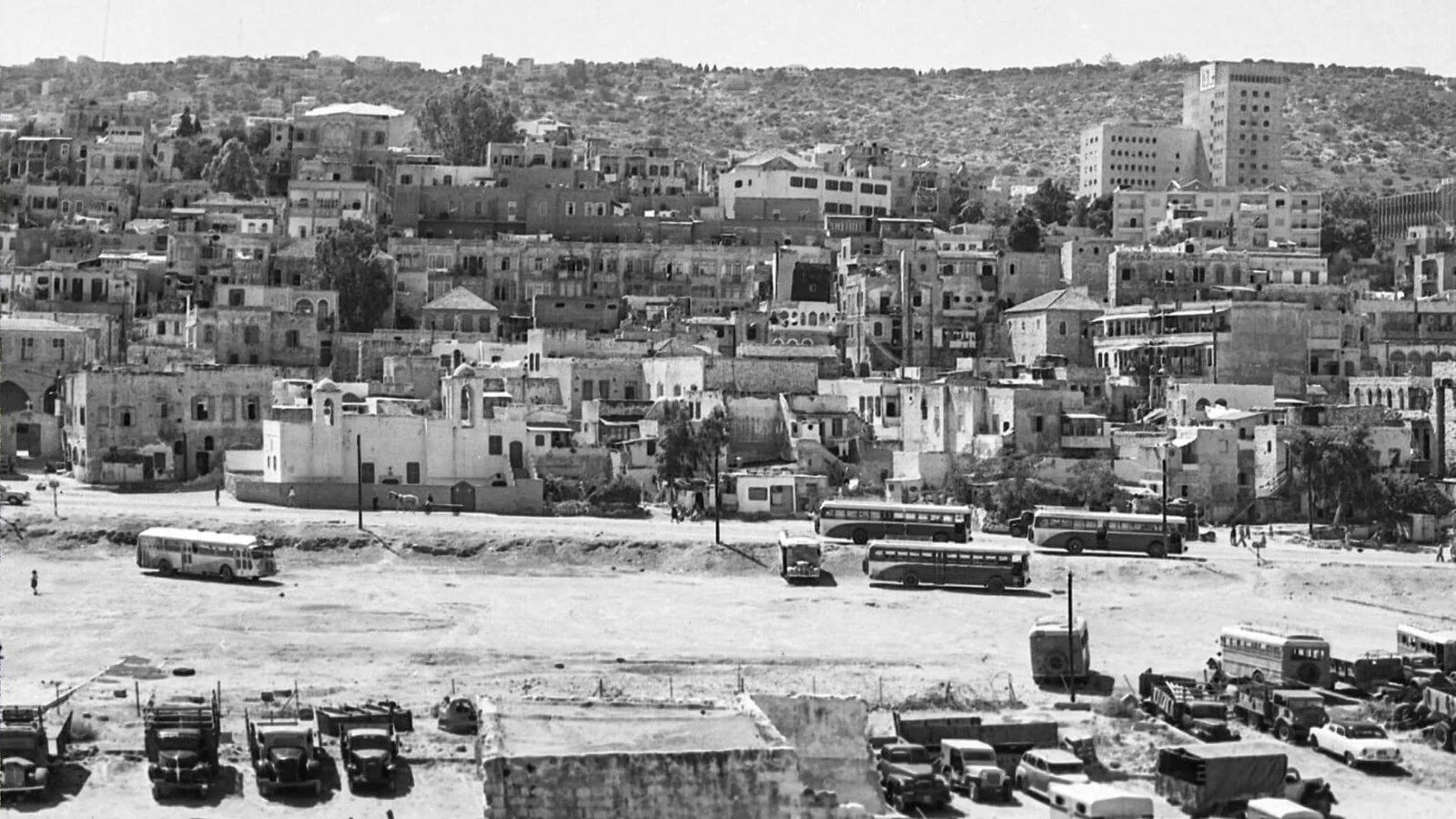
At the beginning of the nineteenth century there were 4,000 Palestinian inhabitants in Haifa, and between 1918 and 1944, the year of my birth, Haifa’s population grew from 15,000 to 130,000, half Jewish and half Palestinian, mostly Muslim but with a significant Christian minority. By the time I was born, most Jewish people lived in Hadar HaCarmel, half-way up Mount Carmel, where my parents had their first apartment, and on the mountain itself, where we moved to as father’s business improved. Most Palestinians, employed in British army bases, the oil refineries, the port and railway services, lived downtown, but a significant wealthy professional and business Palestinian elite lived on Mount Carmel.
The zionist story gives a different version of Haifa as a model of co-existence, a rich texture of nationalities and ethnicities living together in harmony and tolerance in a secular atmosphere, a city of migrants, both Jewish and Palestinian, who established a mixed economy based on Haifa’s strategic position, with Jewish people using their “professional skills and international connections” and Palestinians their “labour, and links with the Arab markets,” making Haifa a “working, open city,” whose many industries lay the foundations for Arab-Jewish cooperation. Zionist scholars such as Tamir Goren and Yif’at Weiss, narrate Haifa as an “urban zionist project,” the only city constructed as a “semi-kibbutz” or “semi-city built of suburban units,” a mixture of western city-centre welfare garden-city neighbourhoods and Bolshevik industrial suburbs, enabled, after 1948, by the re-allocation of what was designated the “deserted” Palestinian property stolen by the zionist entity, which declared their former owners as “present absentees,” to poor North African Jewish migrants.
The battle for Haifa: zionist versus Palestinian narratives

The fate of the so-called “mixed city” of Haifa was sealed on the night between 21 and 22 of April 1948, when members of the local Palestinian national committee met in the home of the manager of the Arab Bank of Haifa. Having understood that defeat was imminent, the following morning they asked the British commander of Northern Palestine, Major General Hugh Stockwell, to convey their surrender to the zionist leadership. That afternoon the Palestinian national committee met the zionist leadership in the town hall to applause by scores of Jews, Haifa having already been conquered by the zionist militia, the Haganah, to sign away their city.
Historian Tamir Goren’s account of the zionist story of the battle for Haifa, and probably my father’s account too, is a story of “Arab riots” in reaction to the rise of the zionist movement and the support of the British. According to the revisionist Israeli “new historian”, Ilan Pappe, the zionist operations in Haifa were retroactively approved and welcomed by the Consultancy, an ad hoc group of zionist leaders assembled solely for the purpose of plotting and designing the dispossession of Haifa’s Palestinian population.
Goren cites the Haganah’s report of the coordinated operation in Haifa as a story of heroism and danger:
As the British evacuated the city, our units began to immediately take key positions, capturing transport routes and army posts. Our units took… the governor’s house, Hadar HaCarmel’s police station, the railway offices… The enemy tried several times to take the building from us, but was defeated… Many enemy bases were captured by our forces… At dawn our units attacked Arab Halissa… all houses were captured after heavy fighting. Arabs are abandoning the neighbourhood… getting women and children out… The enemy suffered many losses in life and property…
Goren’s book has photographs of armed Haganah soldiers patrolling Palestinian Haifa, harassing the local Palestinians. Although extremely difficult, I am intent on editing father into these photographs. He could easily have been one of those part-time soldiers in khaki shorts and knee-length khaki stockings, who set about on the task of “Judaising” Haifa. He said little, but I know he was one of the foot soldiers guarding Wadi Rushmia; my bother, born five days after the declaration of the zionist entity, remembers being told that while father was on guard duty in the Wadi, mother, in labour, was brought by ambulance to the hospital and the ambulance was shot at.
The zionist operation in Haifa was ominously titled “Operation Scissors,” indicating a pincer movement and cutting the city off from its Palestinian hinterland. Since Haifa was allocated in the 1947 UN partition plan to the zionist entity, the zionists were determined to gain control of the port, but without the city’s 75,000 Palestinian inhabitants; this was achieved in April 1948. Pappe outlines the part played by the British in the fall of Haifa – intended to leave the city in May 1948, British troops were present as zionist units captured the Palestinian parts of the city. According to Pappe, British politicians later admitted that the British conduct in Haifa forms “one of the most shameful chapters in the history of the British Empire in the Middle East.”
Pappe’s is the main source of my account of the fall of Haifa; his account is far less sanitised than Goren’s: “The Jewish campaign of terrorisation, begun in December 1947, included heavy shelling, sniper fire, rivers of ignited oil and fuel sent down the mountain-side, and detonated barrels of explosives, and went on for the first months of 1948…” When, on 18 April, the British informed the zionist authorities that they were leaving the buffer zone between the zionist forces and Haifa’s Palestinians, the road was open for the de-Arabisation of Haifa. As I read it, I have a desperate need to speculate whether father was one of the 2,000-strong well-armed Carmeli Brigade zionist soldiers facing a poorly equipped army of 400 local and Lebanese volunteers who had inferior arms and limited ammunition, a poor match for the armoured cars and mortars on the zionist side.
The removal of the British barrier led to “Operation Scissors” giving way to “Operation Cleansing the Leaven.” As the city’s Jewish mayor was beseeching Haifa’s Palestinians to stay, promising no harm would befall them, Haganah loudspeakers were urging Palestinian women and children to leave before it was too late, and the Carmeli commander issued explicit orders to his troops to “Kill any Arab you encounter, torch all inflammable objects and force doors open with explosives.”
Though painful, I must imagine father as one of those who torched objects and forced doors open, and even killed, as the bewildered Palestinians, without packing their belonging, or knowing what they were doing, began leaving en masse, heading towards the port. But I would never know whether father was one of the troops who, once Palestinians left their homes, broke into and looted their houses.

Pappe reports that at dawn on 22 April, Palestinians came streaming into the harbour. The streets in the Palestinian part of the city were overcrowded and their leaders tried to instil some order in the chaos. Loudspeakers could be heard asking people to gather in the old marketplace near the port until an orderly evacuation by sea could be organised. The Carmeli Brigade war book shows little compunction about what happened next. Aware that people were advised to gather by the port, zionist officers ordered their men to station three-inch mortars on the mountain slopes overlooking the market and the port and bombard the gathering crowds below. The idea was to ensure that the flight would be in one direction only; as Palestinians gathered in the beautiful old Ottoman marketplace, they were easy targets for the zionist marksmen. As the shelling began, the crowd broke into the port, storming the boats moored there. According to the Palestinian historian, Walid Khalidi cited by Pappe: “Men stepped on their friends and women on their own children. The boats in the port were soon filled with living cargo. The overcrowding in them was horrible. Many turned over and sank with all their passengers.” House to house searches, arrests and beatings meted out to those who did not leave during these fateful days in April meant that even those who delayed decided to leave. By 1 May only some 4,000 Palestinian were left in Haifa.
Why did they leave Haifa?
Every Palestinian must have asked his or her parents the same question: why did you leave? I imagine that the answer comes always in two stages: first, there are the obvious explanations, the threats, the bombs, the rumours of massacres, the death of close ones, as well as the great fear of rape, the traditional Palestinian man and woman’s paramount anxiety about the loss of honour. Then, after a moment’s silence, there comes the doubt as he or she examines his or her memories, which have, perhaps, begun to fade. Guilt then sets in, embarrassment, a whispering, nagging scepticism: what if I had been cowardly, what if… (Omar Al Qattan).
The story of the de-Palestinianisation of Haifa centres on the key question of whether, as argued by zionist historians, and as my father told it, Haifa’s Palestinian population was instructed by its leaders to evacuate the city despite being asked to stay by the zionist leadership; or whether they were “ethnically cleansed,” as argued by Palestinian historians and revisionist Israeli scholars such as Ilan Pappe. Typically, Goren argues that the zionist leadership tried hard to prevent mass evacuation and that the testimonies of Jews, British and Palestinians alike confirm that “no steps were taken to encourage the Arabs to leave the city.” But in recent years the story has become clearer, supporting the Palestinian insistence on the active role the zionist militias played in the de-Palestianisation of Haifa.
And what about father’s version? I remember him telling me that Haifa’s Jews begged the Palestinians not to leave the city. Though Weiss writes that the zionist leadership was hugely embarrassed, she notes that the embarrassment might have been due to Haifa’s Jews worrying about losing cheap Palestinian labour. After the initial embarrassment, however, the zionist leadership stopped calling upon the Palestinians to stay. Benny Morris writes that the mass Palestinian evacuation wetted the Jewish appetite; he quotes a zionist commentator saying: “at first [we] were interested in keeping the Arabs… then another idea set in, better without Arabs, it’s more convenient.”
Interviewing my dead father?
Miki never spoke about his childhood, or his wars. Only insubstantial narrative fragments survived. The old Parabellum pistol he hid in the linen cupboard for mother to defend herself when he was on Haganah guard duty was returned to the police in the 1960s, after it was discovered by my teenage brothers. He never said whether he had used it and if so, doing what.
But the photographs in Goren’s book kept troubling me as I desperately edited Miki into the picture. I know he stood guard at Haganah posts, but was he there when Palestinian refugees were led in lorry-loads to the harbour? Did he patrol the demolished old city? More crucially, did my father, the sensitive young migrant whose family escaped the outskirts of the empire, witness his city’s Palestinian refugees leave their homes with hastily packed belongings, carrying them on their bent backs?
I cannot ask him now, but the comparison with the “ordinary people” who served in the Nazi Wehrmacht had always troubled me, as did the discovery, in the late 1960s, by the ’68 generation, children of German soldiers, of what their parents did during the war. Listening to zionist interviewees in Dalia Karpel’s documentary about senior Haganah officer Yosef Nachmani talking about shooting a dozen crouched Palestinian refugees hiding in a deserted building during the Nakba, and saying he had no regrets even though some of this friends called him “Nazi,” it may not be such an odd comparison after all.
Memory sites
Why do some people have the power to remember, while others are asked to forget? … No ethical person would admonish Jews to forget the Holocaust… yet in dialogue with Israelis… Palestinians are repeatedly admonished to forget the past… ironically Palestinians live the consequences of the past every day – whether as exiles from their homeland, or as members of an oppressed minority within Israel (George Bisharat).
French historian Pierre Nora’s article on memory sites argues that we continue to speak of memory because there is so little of it, and he claims that we can retain sites of memory because this is the best we can do now there is no spontaneous memory. Nora writes that “lieux de mémoire are fundamentally remains, the ultimate embodiments of a memorial consciousness that has barely survived in a historical age that calls out for memory because it has abandoned it.” The question is whether Nora’s “memory sites” also encompass “sites of silence,” where the landscape itself becomes the site of memoricide rather than memory, as Pappe argues in relation to the erasure of Palestine’s geography by the zionist entity.
In reality, Palestinian Haifa, and in particular Wadi al Saleeb, was largely demolished. The story of the 3,500-5,000 Palestinians left in Haifa after the zionist troops expelled them from the city on 23 April 1948 exemplifies the tribulations of the ongoing colonisation of Palestine ever since that war. Pappe writes that on 1 July, the zionist commander of the city summoned the leaders of the remaining Palestinian community to “facilitate” their transfer from the various parts of the city where they were living into one downtown ghetto, Wadi al Nisnas, the city’s poorest area. Some were told to leave their houses on the slopes of Mount Carmel within four days. The shock was enormous – many of Haifa’s Palestinians belonged to the Communist Party that had supported partition and hoped that now that the fighting was over, they would live peacefully in the zionist entity whose establishment they did not oppose. Despite protests by the leaders, who called the move “ghettoisation,” the Palestinians were commanded to leave and forced to cover the cost of their transfer. Pappe writes that in their new abode, Wadi al Nisnas, which serves the Haifa municipality to cynically celebrate the convergence of Hanuka, Christmas and Id al-Fitr as “the feast of all feasts for peace and coexistence,” they were continually robbed and abused by the right wing Irgun and Stern Gang, with the Haganah standing by and doing nothing.
Today, above al-Istiklal mosque and below Hadar HaCarmel stands the large demolition site of Wadi al Saleeb. According to Weiss, the zionist entity’s citizens know only it because of the 1959 “riots” by its North African Jewish migrant residents, but few remember it had once been a Palestinian Muslim quarter. Over the years there were various plans to turn it into an artists’ quarter, but as the Palestinian scholar Raef Zreik wrote, “years have passed and a new quarter has not yet been built for the Palestinians in Haifa. We have not demanded a new quarter in Haifa.”
For me Palestinian Haifa is a lieu de mémoire constructed in collaboration with the vanished Palestinians, and with the Palestinians who did remain in the city I grew up in shadowing my zionist childhood and youth.
My father, his daughter
Does telling the story of Haifa and speaking about father rather than about the Palestinian survivors of the zionist destruction of Haifa make me as guilty as Theodore Katz, who, according to Samera Esmeir, argued that the contradictory, recursive testimonies of the Palestinian survivors of the zionist Tantura massacre constituted a “failure” of memory? I keep thinking whether I should have concentrated on reading testimonies of the Palestinian survivors of the fall of Haifa. Or would doing that perpetuate their victimhood?
There are many dilemmas involved in representing my father through my “ethnographic I.” Though my father is not available to me to check his version of events, nor am I able to seek his permission to quote from his letters to me, this paper is ultimately about my own Damascene trajectory, from an “ordinary” zionist post-Holocaust childhood to a lifelong opposition to the zionist colonial entity and solidarity with the Palestinian “other.” I borrow from Carolyn Ellis the notion of taking “retrospective field notes” of my life, since, apart from his letters to me, and a few photographs, I have no documentary evidence to substantiate my strong feeling that my life and political commitment to the liberation of Palestine have been shaped by Miki’s life (though not by his political commitment).
While father did not migrate to Palestine as a zionist idealist but because his father could not make a living in pre-Nazi Vienna, he became a zionist, trying to create for me what must be described as an “ordinary zionist childhood,” compete with pre-military school training, and with hikes aimed to “conquer the land with our feet.” But growing up in Haifa, where some Palestinians were allowed to remain, albeit concentrated in their downtown ghettos, meant the seeds of doubt had been sown early on. Just as I listened to the stories that mother’s relatives were telling about their Romanian Holocaust, which they didn’t want us children to hear, so I also heard the background music of the Nakba. I heard it through mother telling me repeatedly how she used to mutter “I hate Arabs” as she rushed to the pistol father had hidden for her in the linen cupboard when he was on guard duty, while holding me, her asthmatic baby, and minding his elderly mother. And through the fragments father never spoke about, but which were in the air.
We were an argumentative family – from an early age father called me “the leader of the opposition.” Did this preordain my lifetime of political dissent? I argued with him for years, and after the 1967 Naksa our arguments became politically bitter.
Miki died prematurely, a few months after the 1973 war. Towards the end of his life, he became despondent. His huge achievements – he designed and produced the first Israeli-made washing machine, and was an accomplished painter – did not assuage his depression. In the last year of his life, after I had migrated to Ireland, Miki wrote me a series of letters, the first just after the outbreak of the 1973 war. These honest and painful letters that denote his doubt, worry and despair, are important to my attempt to understand him, to understand me, and I hope he may have agreed to my quoting some fragments:
- “I was hoping they would mobilise me, but apparently they have enough old men…” (7/10/73).
- “We are all looking for developments in Geneva, even though the opening speeches were not encouraging. Hatred sounded from every word and I feel we are really isolated. This makes me think that perhaps we are to blame after all” (23/12/73).
- “As far as I am concerned, I am tired of all the victories. I would like to think that the future might bring some peace, although I am not too sure if we can live in peace. It seems to me that if the Arabs want to liquidate us, all they have to do is make peace with us…” (22/1/74)
By May 1974 his doubts were more explicit:
- “Hard times… Is humanity really that cruel and selfish, or is the blame in us? I find it hard to decide… After all, we did not seek wars and conquests… or perhaps I am wrong, and we sought imperialism and oppression? … I can see no ray of hope and I don’t know what to do, how can a simple man like me express his views?” (22/5/74)
In his last letter, written just four days before he died of a sudden coronary, Miki, who had just enlisted in the civil guard, described himself as the “brave soldier Schweik patrolling the streets once a week… they may even give me a gun” (23/6/74).

It is as impossible for me to fathom what went on in Miki’s mind in these final days as it is to gauge the extent of his part in perpetrating the Haifa Nakba. Probably, like Yosef Nachmani, Miki believed in the justice of the zionist cause while at the same time feeling revulsion at the excesses of the power-hungry entity. But, like Nachmani, my father bore responsibility for his part in perpetrating the Haifa Nakba. I, his daughter, take on this responsibility, even though I believe it was his assigning me the role of an anti-zionist oppositionist from a very young age that shaped my life-long political dissent and solidarity with my Palestinian sisters and brothers. From the distance in time and place, it is Miki’s self image as the “brave soldier Schweik,” a comic World War I reluctant soldier, that enables me to make sense of his Nakba days. It makes it somewhat easier to reconcile with what Esmeir calls “the year of conquest,” whose survivors lived on out of death, “their memories, as articulated by the silences, the multiple experiences, the various perspectives, are all indicators of the historical, of that which took place.’”
You must be logged in to post a comment.